YourChoice Concierge

Why You Need a Not-To-Do List
Stephanie
07-31-26 11:09 AM Comment(s)

Why You Need a Not-To-Do List

YourChoice Concierge

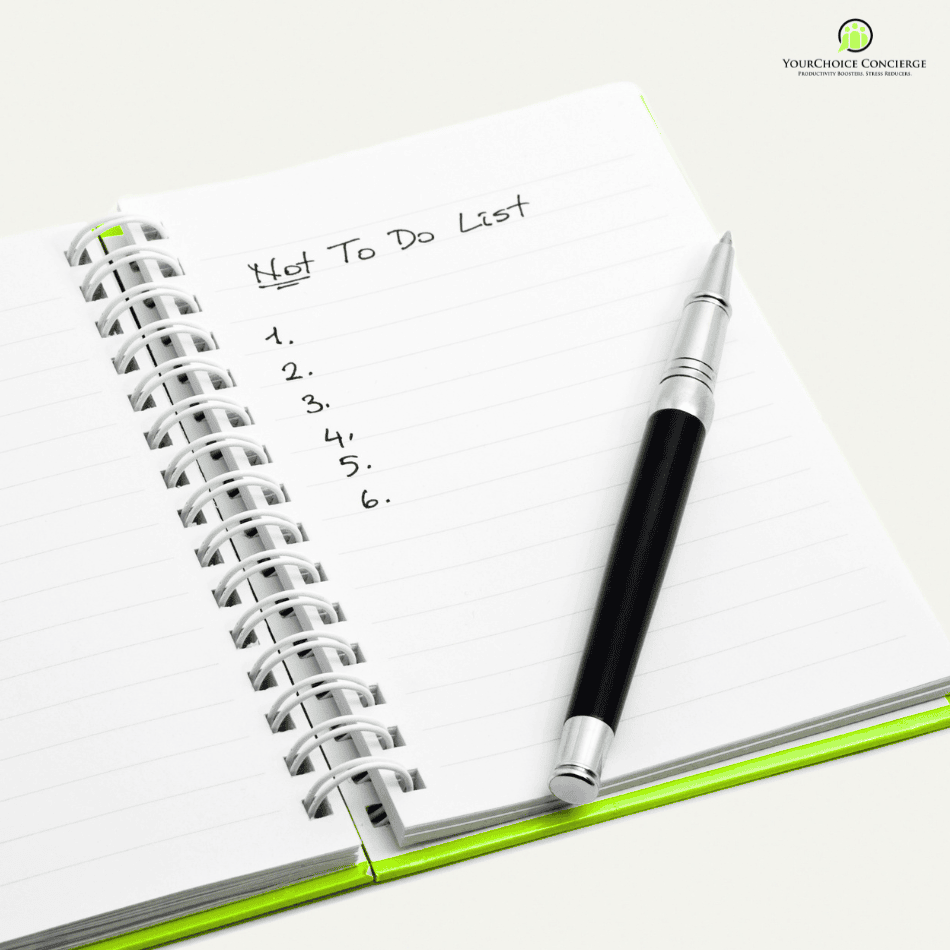
Most people have a to-do list. Hopefully, you have one sitting on your desk right now because honestly, how does anyone function without one? (Seriously!) I know I couldn't accomplish half of what I need to without writing things down. But today, I want to introduce you to a productivity tool that completely changed the way I think about managing my time. It's called a Not-To-Do List.


At first, it might sound counterintuitive. We're constantly taught to focus on what we should be doing. We make endless lists of tasks, goals, errands, and responsibilities. But what if the reason you never feel caught up isn't because your to-do list is too long? What if it's because your Not-To-Do List doesn't exist? True productivity isn't just about deciding what deserves your attention. It's equally about deciding what doesn't.

We've Been Measuring Productivity All Wrong

Many of us grew up believing productive people simply do more.

More meetings.

More emails.

More projects.

More commitments.

More hustle.

Our culture often celebrates being "busy" as a badge of honor. But being busy and being productive are two very different things. According to research from the Organization for Economic Co-operation and Development (OECD), countries with the longest working hours are often not the most productive. Instead, productivity increases when people work smarter—not simply longer. That's an important distinction. Working more hours doesn't automatically produce better results. In fact, after a certain point, it often creates diminishing returns.

Your Attention Is Your Greatest Resource

One of the biggest productivity killers isn't laziness—it's constant interruption. Harvard Business Review has published multiple studies showing that frequently switching between tasks decreases productivity while increasing mistakes. Researchers have also found that it can take approximately 23 minutes to fully regain focus after an interruption. Think about that for a moment. If you're interrupted just ten times throughout your workday, you could lose several hours of productive time—not because you weren't working hard, but because your attention kept getting pulled in different directions. This is why learning to protect your focus is far more valuable than simply adding another productivity app or time-management technique.

YourChoice Concierge

The Power of Subtraction

If doing more isn't the answer, what is? The answer begins with doing less of the wrong things. Every time you say yes to one task, you're automatically saying no to something else. Economists call this opportunity cost. Every decision has a tradeoff. Imagine spending two hours organizing digital files. Those same two hours could have been spent:

  • Growing your business
  • Meeting with clients
  • Creating marketing content
  • Exercising
  • Spending time with your family
  • Relaxing
  • Working on a passion project

Your time is finite. Your energy is finite. Your attention is finite.


Every unnecessary task steals from something more valuable. Instead of constantly asking, "What else should I add?" try asking: "What can I remove?" That single question can completely transform your productivity.

Why Delegation Feels So Difficult

If delegation is so beneficial, why don't more people do it? Usually, it comes down to four common beliefs.

1. "I Can Do It Faster Myself." Sometimes that's absolutely true. Teaching someone else takes time. But while doing it yourself may save time today, teaching someone once can save hundreds of hours over the coming months or years.
2. "No One Will Do It As Well As I Do." This is often perfectionism disguised as high standards. Research by Dr. Brené Brown and other organizational psychologists has consistently linked perfectionism with burnout, anxiety, and reduced innovation. Perfection isn't the goal. Progress is.
3. "It's Easier If I Just Do It." Again...Today? Probably. Next month? Probably not. The short-term convenience often creates long-term overload.
4. "I Should Be Able to Handle Everything." This belief is especially dangerous because it confuses independence with strength. The most successful leaders don't do everything. They build systems. They build teams. They build support.

Ask Yourself One Powerful Question

Whenever a new task lands on your plate, pause and ask yourself: "Am I the only person who can do this?"
Notice the question isn't: "Can I do it?"
Most capable people can accomplish almost anything given enough time. The better question is: Should you?
If someone else can successfully handle the task, it probably belongs on your Not-To-Do List.

YourChoice Concierge

What Belongs on a Not-To-Do List?

Many people struggle to think of tasks they could remove or delegate. Here are a few ideas of tasks you can delegate:
  • Scheduling appointments
  • Running errands
  • Ordering supplies
  • Managing your inbox
  • Travel planning
  • Data entry
  • Bookkeeping
  • Research
  • Gift purchasing
  • Household management
  • Laundry
  • Meal planning
  • Coordinating vendors

Tasks You Should Eliminate:
  • Meetings without agendas
  • Checking email every five minutes
  • Scrolling social media during work hours
  • Saying yes to every request
  • Doing favors that leave you feeling resentful
  • Tasks You Can Automate
Every task you eliminate creates more space for meaningful work.

Decision Fatigue Is Real

Psychologist Roy Baumeister introduced the concept of decision fatigue, suggesting that making repeated decisions throughout the day gradually depletes our mental energy. Think about how many decisions you make before lunchtime. What should I wear? What should I eat? Should I answer this email now? Should I fold laundry? Should I go to the store? Should I call them back?

By the afternoon, your brain is exhausted—not necessarily because you've worked harder, but because you've made hundreds of decisions. That's one reason successful people often simplify routine choices. Steve Jobs became well known for wearing a consistent outfit most days. The goal wasn't fashion—it was eliminating one unnecessary decision. The point isn't that you should wear the same clothes every day. The point is to protect your mental bandwidth for decisions that actually matter. Your Not-To-Do List helps you do exactly that.

This Is About More Than Productivity

A Not-To-Do List protects more than your calendar. It protects your:
  • Mental health
  • Relationships
  • Creativity
  • Energy
  • Patience
  • Sleep
Every unnecessary commitment creates invisible stress. And stress compounds over time. According to the American Psychological Association, chronic stress is associated with reduced concentration, poorer memory, lower productivity, and a greater risk of burnout. Removing unnecessary obligations isn't being lazy. It's protecting your capacity to perform at your best.

YourChoice Concierge

You Don't Have to Do Everything Yourself

This is exactly why YourChoice Concierge was created. Over the years, I've spoken with countless entrepreneurs, professionals, and busy families who all tell me the same thing: "I wish I had more time". But what they usually mean is: "I wish I wasn't spending so much time doing things someone else could do".

Sometimes the biggest productivity boost isn't finding another app. Or buying another planner. Or learning another time-management strategy. Sometimes it's simply deciding that you don't have to do it all yourself.

Delegating doesn't mean you're incapable. It means you're intentional. It means you recognize that your time is valuable and you're choosing to spend it where you make the greatest impact.

Whether that's growing your business, spending more quality time with your family, or finally taking the break you've been putting off, protecting your time is one of the smartest investments you can make.

At YourChoice Concierge, we help individuals, families, and businesses reclaim their time through flexible personal assistance, administrative support, and virtual services—all by the hour, with no long-term commitments.

Because productivity isn't about doing everything. It's about making sure you're doing the right things.

Final Thoughts

The next time you sit down to write your to-do list, take a few extra minutes to create a Not-To-Do List alongside it. Ask yourself: What am I ready to stop doing?

You may find that your biggest productivity breakthrough doesn't come from adding another task. It comes from finally giving yourself permission to let one go. After all, you don't have to do everything to accomplish great things. Sometimes the most productive thing you can do is decide what you'll stop doing.

Stephanie